

Eight years ago, I sat in front of a blank WordPress dashboard, convinced I was about to build the next big blog. I had a domain name, a free weekend, and absolutely no idea what I should write about. I picked a topic in about ten minutes. Eighteen months later, I had 41 posts, 212 monthly visitors, and zero income.
That painful experience taught me the most important lesson of my blogging career: your niche decides almost everything. It affects your traffic, your motivation, your income, and whether you are still blogging a year from now.
In this guide, I’ll show you how to choose a blog niche for beginners using the exact process I now use with every new blog and every student I mentor. If you want to know how to choose a blog niche for beginners without wasting months on the wrong topic, this is the step-by-step system I wish I had on day one.
By the end of this article, you will have a clear niche, a way to test it, and the confidence to start writing.
Why Learning How to Choose a Blog Niche for Beginners Matters More Than Your Blog Name
Most beginners spend weeks agonizing over a domain name and then pick a niche in five minutes. That is backwards.
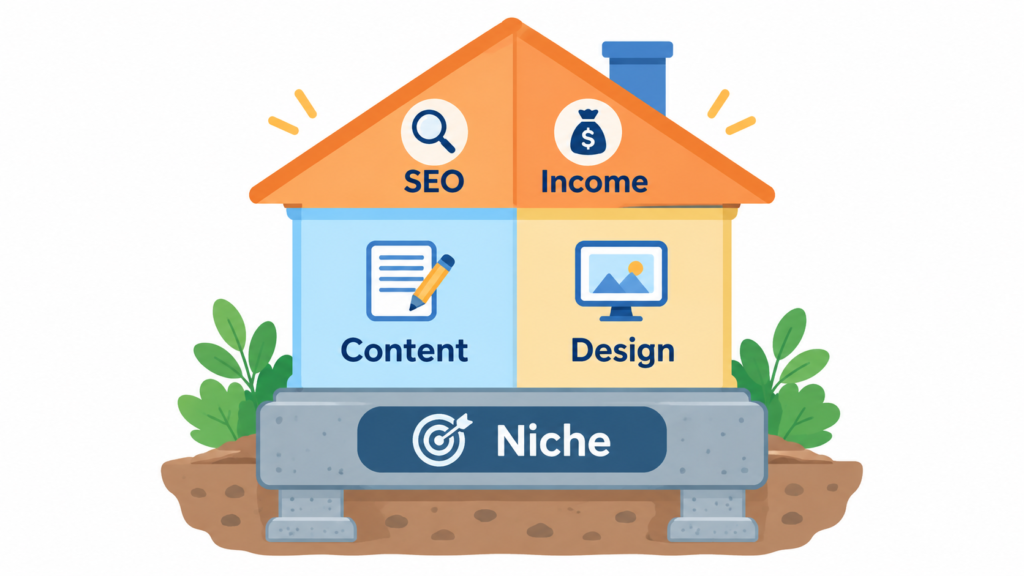
Your niche is the foundation of your blog. If the foundation is weak, no amount of beautiful design, clever SEO tricks, or social media posting will save it. Understanding how to choose a blog niche for beginners early on helps you:
- Rank faster on Google. Google prefers websites that show deep expertise on one subject. A blog that covers a single topic well will earn trust and rankings far sooner than a blog that covers everything.
- Build an audience that sticks. People subscribe to blogs that solve a specific problem for them, not blogs that post random thoughts.
- Earn money sooner. Affiliate programs, ad networks, and sponsors all pay more when your audience is focused.
- Stay motivated. Writing 100 articles about something you find boring is nearly impossible.
I have watched dozens of beginners quit within six months. In almost every case, the real reason was not “blogging is too hard.” It was “I picked a niche I didn’t care about” or “I picked a niche with no clear audience.” That is why I believe how to choose a blog niche for beginners is the single most valuable skill to learn before you write your first post.
My Story: Three Failed Blogs Before I Got It Right
Let me be honest about my mistakes, because they are the most useful part of this article.
Blog #1: The “I’ll write about everything” blog. I wrote about travel on Monday, recipes on Wednesday, and tech gadgets on Friday. I thought variety would attract more readers. Instead, nobody knew what my blog was about, including Google. After a year, I had around 200 visitors a month and nobody subscribed.
Blog #2: The “I’ll copy what’s trending” blog. A friend told me crypto blogs were making a fortune, so I started one. I knew almost nothing about crypto. I rewrote other people’s articles, and my content was thin and unconvincing. The topic was also extremely competitive and full of established experts. I gave up after eight months.
Blog #3: The “I love it but nobody wants it” blog. This time I picked something I truly enjoyed, vintage typewriter restoration. I loved it, but the audience was tiny, and there were almost no products to promote. I made about $14 in total.
Blog #4 finally worked. It was about personal finance for freelancers, a topic I understood from my own experience, with a clear audience and plenty of monetization options. It reached 30,000 monthly visitors in its second year.
What was the difference? I stopped guessing and started following a process. That process is exactly how to choose a blog niche for beginners in a way that avoids all three of my early failures, and I’ll walk you through it now.
What Is a Blog Niche? (A Simple Explanation)
Before we go deeper into how to choose a blog niche for beginners, let’s make sure we are using the same language.
A blog niche is the specific topic or area your blog focuses on, combined with the specific audience you serve. “Food” is not a niche. It is a huge category. “Quick vegetarian dinners for busy college students” is a niche.
A simple formula I use:
Niche = Topic + Audience + Angle
- Topic: What you write about (personal finance)
- Audience: Who you write for (freelancers)
- Angle: What makes your approach different (irregular income and tax tips)
The tighter your niche, the easier it is to become the go-to resource. As a beginner, you do not have a big team or a huge budget, so you win by being specific.
Step by Step: How to Choose a Blog Niche for Beginners Using the 3-Circle Method
Here is the system I use. I call it the 3-Circle Method because the perfect niche sits where three circles overlap: Passion, Knowledge, and Profit. Follow each step in order.

Step 1: List Your Interests and Passions
Grab a notebook and set a timer for 15 minutes. Write down every topic you enjoy, would happily read about on a Saturday, or find yourself explaining to friends. Do not filter yet.
Ask yourself:
- What do I spend my free time on?
- What YouTube channels or podcasts do I follow?
- What would I read about even if I never got paid?
- What do my friends ask me for advice on?
When I did this exercise for the first time, I wrote 47 items. Personal finance was number 31, and I almost skipped it because I thought it was “too boring.” That boring topic became my most successful blog.
Beginner tip: Aim for at least 20 ideas. The best ideas often show up after the obvious ones run out.
Step 2: List Your Skills, Experience and Knowledge
You do not need to be a world-famous expert. You only need to be one or two steps ahead of your reader. In fact, beginners often write the best tutorials because they remember what confused them.
Write down:
- Your job and past jobs
- Your education or training
- Problems you have solved in your own life (debt, weight loss, learning a language)
- Skills people compliment you on
A student of mine named Priya worked as a nurse and wanted to blog about “something fun.” After this step, she realized her most valuable knowledge was how to survive night shifts. She started a blog for new nurses about night-shift health, sleep, and routines. Within eight months, she was getting steady traffic and her first brand deals. Her experience, not a degree or a fancy title, was her advantage.
Step 3: Identify Problems You Can Solve
Here is something many people overlook when learning how to choose a blog niche for beginners: successful blogs solve problems. Nobody wants to read about your day. They want to fix something, learn something, or feel something.
Look at your two lists from steps 1 and 2 and ask:
- What problems do people in this area have?
- What questions do they ask over and over?
- What do they struggle to find clear answers for?
Great places to find real problems:
- Reddit communities and Facebook groups
- Quora questions
- Amazon book reviews (read the 3-star reviews)
- YouTube comments
- Google’s “People Also Ask” boxes
When I researched freelancers, I found the same complaint again and again: “I never know how much to set aside for taxes.” I wrote one article answering that question, and it still brings in traffic today.
Step 4: Check the Market Demand
Passion alone is not enough. This is where my typewriter blog failed. You need to confirm that real people are searching for your topic.
Use these free or cheap tools:
- Google Trends: Is interest growing, steady, or dying?
- Google autocomplete: Type your topic and see what Google suggests.
- Answer The Public or AlsoAsked: See the questions people ask.
- Ubersuggest, Keywords Everywhere, or Google Keyword Planner: Check search volume.
- Pinterest and YouTube search: See if people are actively looking for content.
A healthy niche should have at least 20 to 30 different keywords or questions with decent search volume. If you cannot find that many, the niche may be too narrow.

Step 5: Analyze Your Competition (Don’t Fear It)
Many beginners panic when they see competitors. In reality, competition is a good sign. It proves there is an audience and money in the niche. A niche with zero competition usually has zero demand.
Search for your niche keywords and study the top 10 results. Ask:
- Are the top results from huge brands, or from small independent bloggers? (Small bloggers ranking means you can too.)
- Are the articles outdated or shallow?
- Do they ignore a certain audience or angle?
- How often do they publish?
When I started my finance blog, “personal finance” was dominated by giant publications. But “finance for freelancers with irregular income” had only a few small blogs. That gap was my entry point.
The key lesson in how to choose a blog niche for beginners is this: don’t compete head-on with giants. Find a smaller pond where you can become the biggest fish.
Step 6: Narrow Your Niche (Go Specific)
This step is where most beginners go wrong. They stay too broad. Broad niches are crowded, and your tiny new blog gets lost.
Use the “niche down” ladder:
- Broad category: Health
- Narrower: Fitness
- More specific: Home workouts
- Very specific: Home workouts for busy moms over 35
- Angle: 20-minute routines with no equipment
You do not need to go all the way down to level 5, but you should usually get to level 3 or 4. You can always expand later once you have authority. Starting narrow and growing wider is much easier than starting wide and trying to narrow down.
Step 7: Check the Monetization Potential
Even if you blog as a hobby today, you may want income later. Before committing, check that the niche has real ways to earn:
- Affiliate programs: Are there products or services you can recommend?
- Display ads: Is traffic in this niche valuable to advertisers?
- Digital products: Could you sell courses, templates, or ebooks?
- Services: Could you offer coaching, freelancing, or consulting?
- Sponsorships: Do brands in this niche pay bloggers?
A quick test: search for “[your niche] affiliate program.” If you find several reputable ones, that’s a good sign. If you find none, think carefully.
If you are serious about how to choose a blog niche for beginners the right way, always check money potential before you fall in love with a topic. I learned that lesson the hard way, $14 at a time.
Step 8: Test Your Niche Before Committing
Before you buy hosting for three years or design a logo, run a small test. This is a step almost nobody teaches, and it has saved my students months of work.
Try this 14-day test:
- Write down 30 article ideas for your niche. If you struggle to get past 15, the niche may be too narrow or too boring for you.
- Write 3 sample articles. Do you enjoy it?
- Share one idea in a relevant Facebook group or on Reddit. Does anyone respond?
- Create a simple Pinterest pin or short social post and see if anyone engages.
If you finish the test excited and with plenty of ideas, you probably have a winner. If you feel dread, go back to Step 1. That is not failure. It is the whole purpose of the test.
25 Beginner-Friendly Blog Niche Ideas to Spark Your Thinking
If you’re still stuck, these ideas might help. Remember to narrow them down using the steps above.
Money and career
- Personal finance for freelancers
- Side hustles for students
- Remote work tips for parents
- Resume and interview coaching
Health and lifestyle
- Home workouts for beginners
- Healthy meal prep for busy families
- Mental wellness for new moms
- Minimalism for small apartments
Hobbies and creativity
- Budget travel for solo travelers
- Digital photography for beginners
- Gardening in small spaces
- DIY home decor on a budget
Technology and skills
- WordPress tips for small business owners
- Productivity apps for students
- Learning to code in your 30s
- AI tools for everyday work
Family and relationships
- Homeschooling resources
- Pet care for first-time dog owners
- Wedding planning on a budget
- Parenting toddlers with ADHD
Niche passions
- Sustainable fashion
- Language learning through travel
- Board games for families
- Vegan baking
These are only starting points. The best niche for you is the one that fits your own passion, knowledge, and market demand. That personal fit is the heart of how to choose a blog niche for beginners.
7 Mistakes I Made (So You Don’t Have To)
After eight years, I have a long list of mistakes. Here are the biggest ones that beginners repeat.
1. Choosing a niche only because it pays well. I chased crypto because of the money, and I lasted eight months. Without genuine interest, you will burn out.
2. Being too broad. My “everything” blog confused readers and search engines alike.
3. Being too narrow. My typewriter blog had too few readers to ever grow. There is a sweet spot between too broad and too narrow.
4. Ignoring search demand. I assumed that because I loved something, others would search for it. They didn’t.
5. Copying other bloggers. Copying a competitor’s niche without adding your own angle or experience produces boring content that never ranks.
6. Switching niches every few months. Early on, I changed direction whenever traffic was slow. Blogs usually take 6 to 12 months to gain traction. Give your niche at least a year before judging it.
7. Overthinking it. I once spent three weeks researching and never wrote a single article. A “good enough” niche that you act on beats a “perfect” niche you never start.
If I could go back, I would tell my younger self to follow the process in this guide on how to choose a blog niche for beginners and start writing within two weeks.
Real Examples: Beginners Who Chose the Right Niche
Seeing the method in action helps. Here are three examples from bloggers I have mentored, with details simplified.
Example 1: Daniel, the former teacher.
Daniel wanted to start a general “education” blog. Using the 3-circle method, he narrowed it to “study techniques for adult learners returning to college.” Competition was low, and the audience was clearly searching for help. He now earns from affiliate links to study tools and an ebook.
Example 2: Maria, the budget traveler.
Maria loved travel, a very crowded niche. After the narrowing exercise, she chose “weekend trips under $300 from Chicago.” The local angle made her stand out, and she ranked for long-tail searches within months.
Example 3: Ahmed, the IT worker.
Ahmed knew technology but hated writing about “tech news” because everyone does it. He chose “cybersecurity basics for small business owners.” It matched his job knowledge, had strong demand, and had excellent monetization potential through software affiliate programs.
Notice the pattern. None of them picked a huge topic. All of them combined personal experience with a clear audience. That pattern is the essence of how to choose a blog niche for beginners successfully.
[IMAGE 6 – Prompt]: Three simple character cards side by side showing a teacher, a traveler and an IT worker, each with an icon and a short niche label beneath them. Flat vector illustration, friendly style, soft pastel background.
Alt text: examples of beginners who picked the right blog niche
What If You Have Many Interests and Can’t Decide?
This is the most common question I receive. If you are torn between several topics, try these approaches.
Use a scoring system. List your top 3 to 5 niche ideas. Score each from 1 to 10 on passion, knowledge, demand, competition, and monetization. Add up the scores. The highest total is usually your best choice.
Combine two interests. Sometimes the magic is in the overlap. “Fitness plus busy parents” or “Cooking plus budgeting” can create a unique angle that few others cover.
Pick one and start. Remember that you can adjust later. Several successful bloggers I know pivoted slightly after their first year without losing their audience. You are choosing a starting point, not signing a lifetime contract.
This is a core piece of how to choose a blog niche for beginners: progress beats perfection.
What If You Think You Aren’t an Expert?
Beginners often tell me, “Who am I to teach this?” I felt the same way.
You do not need to be the world’s top expert. You can:
- Document your journey. Write as you learn. Readers love honest progress stories.
- Interview experts. Quote professionals and add your own perspective.
- Research deeply. Combine reliable sources with your own experiments.
- Be transparent. Say clearly what you know and what you are still learning.
Trust comes from honesty, not perfection. When I started the finance blog, I openly shared my own debt mistakes. Readers responded far more strongly to that honesty than to polished advice.
Quick Checklist: Is This the Right Niche for You?
Before you finalize your choice, answer these questions honestly:
- Can I see myself writing about this for at least two years?
- Do I have at least 30 article ideas?
- Are real people searching for this topic?
- Is there a clear audience with a clear problem?
- Are there ways to make money from it?
- Can I offer a unique angle or experience?
- Did I pass the 14-day test?
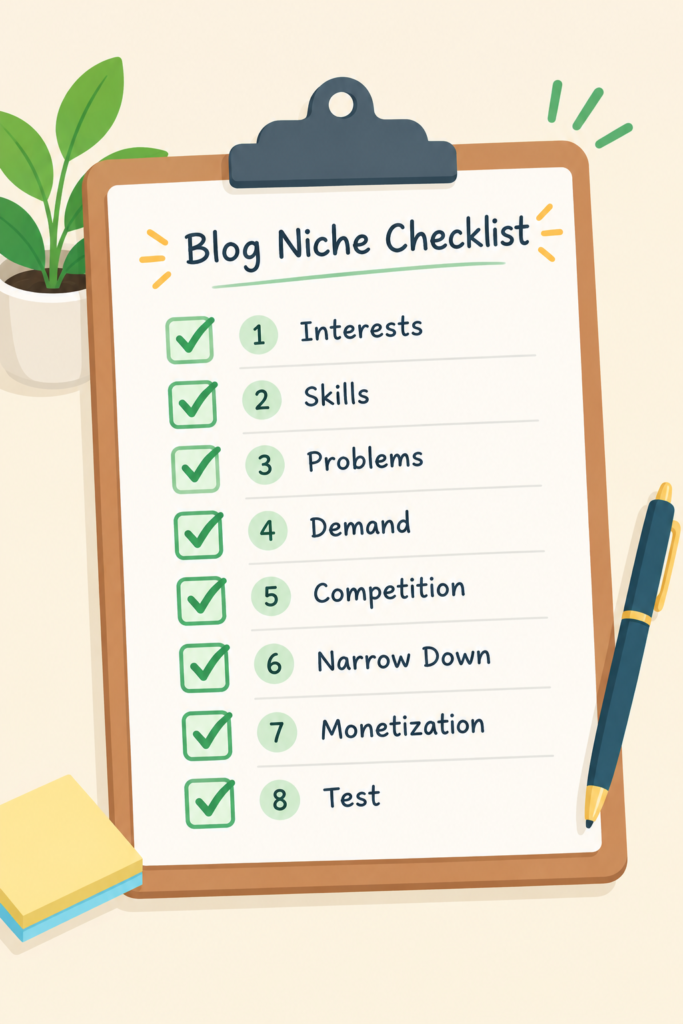
If you answered “yes” to at least six of seven, you have likely found a strong niche. This simple checklist captures everything about how to choose a blog niche for beginners in one place, and I suggest saving it.
What to Do After You Choose Your Niche
Choosing is only the first step. Here is the sequence I recommend next:
- Pick a blog name and domain that reflects your niche.
- Set up hosting and WordPress. A basic plan is enough at first.
- Create 5 to 10 pillar topics within your niche.
- Write your first 10 articles targeting low-competition keywords.
- Set a publishing schedule you can realistically keep, such as one or two posts a week.
- Learn basic on-page SEO (titles, headings, internal links, meta descriptions).
- Promote your content on Pinterest, social media, or relevant communities.
Be patient. Most blogs need several months before Google sends meaningful traffic. The bloggers who succeed are those who keep publishing after the excitement fades.
FAQs About How to Choose a Blog Niche for Beginners
1. How do I know if a blog niche is profitable?
Check for affiliate programs, products people buy, advertiser interest, and demand for services. If you can find several ways to earn, the niche is likely profitable.
2. Can I change my blog niche later?
Yes, but it is easier early on. A small pivot or expansion is fine. A complete change after hundreds of posts can hurt traffic. This is why learning how to choose a blog niche for beginners carefully at the start is so helpful.
3. How narrow should my niche be?
Narrow enough that you can describe your reader in one sentence, but broad enough that you can write at least 50 to 100 articles.
4. Should I choose a niche I’m passionate about or one that makes money?
Both. The best niche sits where passion, knowledge, and profit overlap. Passion alone may not earn money, and money alone will not keep you writing.
5. How long does it take to choose a niche?
With the steps above, one to two weeks is plenty. Do not spend months on it.
6. Is it too late to start a blog?
No. People search for answers every day, and there is always room for a fresh voice with a specific angle.
Final Thoughts on How to Choose a Blog Niche for Beginners
If you take only one thing from this article, let it be this: your niche is a decision, not a destiny. You do not need the perfect answer. You need a good answer that combines something you care about, something you know, and something people want.
To recap, here is how to choose a blog niche for beginners step by step:
- List your interests
- List your skills and experience
- Identify problems you can solve
- Check market demand
- Analyze the competition
- Narrow your niche
- Check monetization potential
- Test before you commit
I made every mistake possible in my first three years, and each one cost me time and money. You now have the shortcut. Take 15 minutes today, open a notebook, and complete Step 1. Momentum matters more than certainty.
And once you begin, stay consistent. Blogging rewards those who show up. The niche you choose today could be the one that changes your career, your income, and your life a year from now.
[IMAGE 7 – Prompt]: An inspiring illustration of a person standing at the start of a winding path leading toward a glowing sunrise, with a laptop in hand and small icons for “ideas,” “traffic” and “income” along the way. Warm gradient colors, motivational blog-ending style.
Alt text: starting your blogging journey after choosing a niche
Meta Description
How to Choose a Blog Niche for Beginners: Step by Step. Learn how to choose a blog niche for beginners with an 8-year blogger’s proven 8-step method, real examples and mistakes to avoid.
URL slug: /how-to-choose-a-blog-niche-for-beginners