
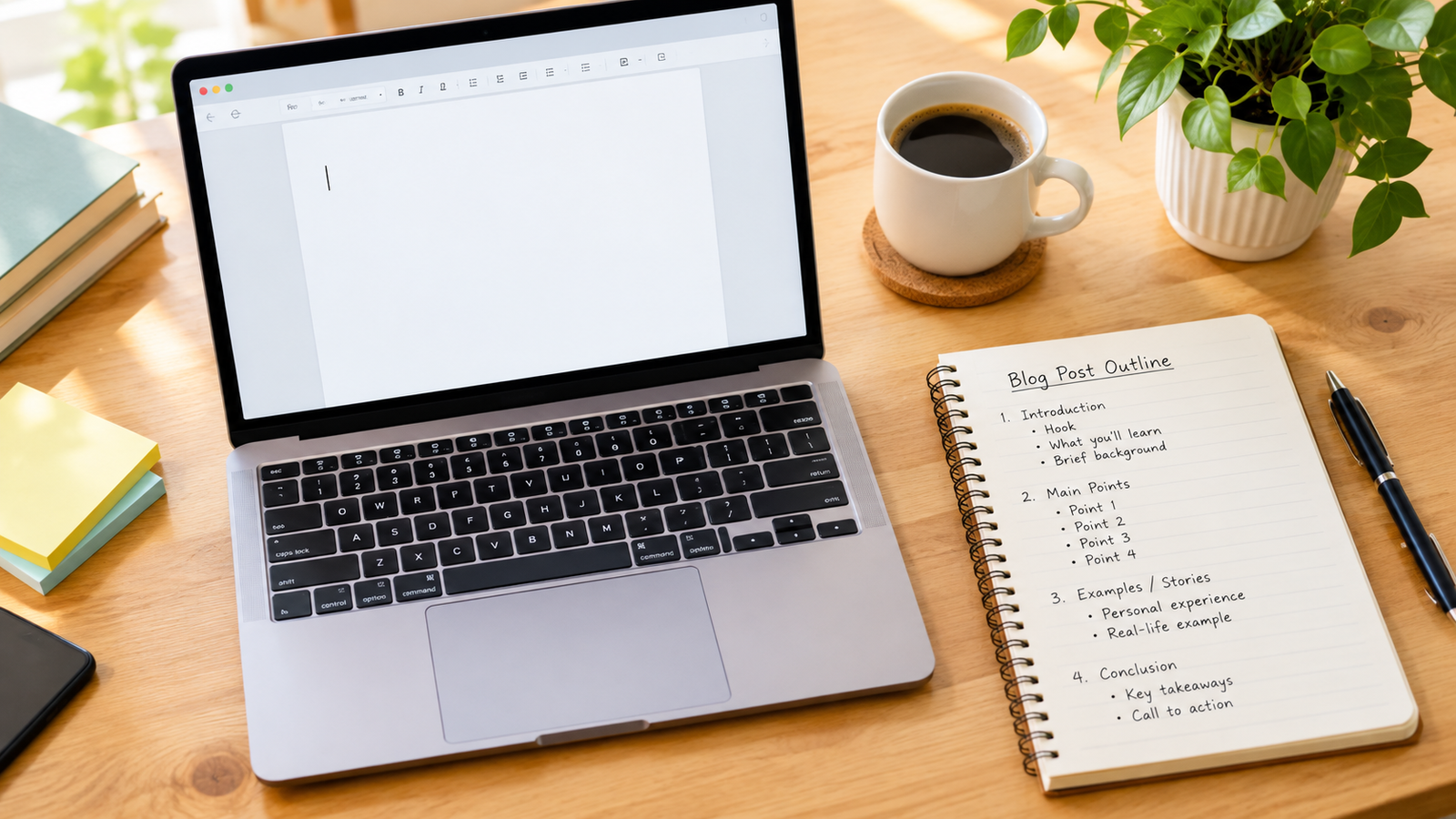
I still remember the night I clicked “Publish” on my very first blog post. My heart was pounding, my coffee had gone cold, and I was sure the internet was about to notice me. It did not. In its first month, that post got 9 visits, and 6 of them were me checking that it had gone live.
Looking back, that post was a mess. The title was vague, the introduction rambled for 300 words, the paragraphs were giant walls of text, and I had no idea who I was writing for. I spent the next eight years fixing those mistakes across several blogs. The difference was never talent. It was a repeatable process.
In this guide, I’ll show you how to write first blog post for beginners using the exact process I now teach every new blogger I mentor. If you want to know how to write first blog post for beginners without freezing in front of a blank page, this is the step-by-step method I wish someone had handed me on day one.
By the end, you will know what to write, how to structure it, how to make it search-friendly, and how to hit publish with confidence.
“Whether you are starting a hobby blog or a business site, learning how to write first blog post for beginners is the best first step.”
Why You Can Trust This Guide on How to Write First Blog Post for Beginners
Let me be upfront about my background. I have been blogging for eight years, across several niches. [Add one real detail here, such as your niche, a post that ranks, or the number of beginners you have helped.] My first post was a failure. My second post taught me more than my first fifty hours of reading about blogging.
Everything in this guide comes from things I have actually done, including the mistakes. When I share a story, it is because it taught me something. When I give a rule, it is because it saved me time. That is the standard I hold myself to, and it is the same standard Google asks of content: real experience, real expertise and honest advice.“That is why I’m confident this guide on how to write first blog post for beginners will work for you too.”
Why Learning How to Write First Blog Post for Beginners Matters
Many beginners treat the first post as a throwaway. They think, “I’ll write something quick, and the good posts will come later.” I made the same mistake. But your first post matters more than you might expect.
Here is why learning how to write first blog post for beginners the right way is worth your time:
- It sets your writing standard. The first post becomes the template for every post after it.
- It builds momentum. Finishing and publishing one good post gives you the confidence to write the next ten.
- It starts your SEO clock. Google needs time to find, crawl and trust a new site. The earlier you publish a well-optimized post, the earlier that clock starts.
- It teaches you the whole process. One complete post, from idea to promotion, shows you every skill you need.
I have mentored people who spent three months “preparing” and never published a word. Others published a rushed post and never improved it. The ones who succeeded followed a simple process, which is why I think this is the most practical skill to learn right after choosing your niche.
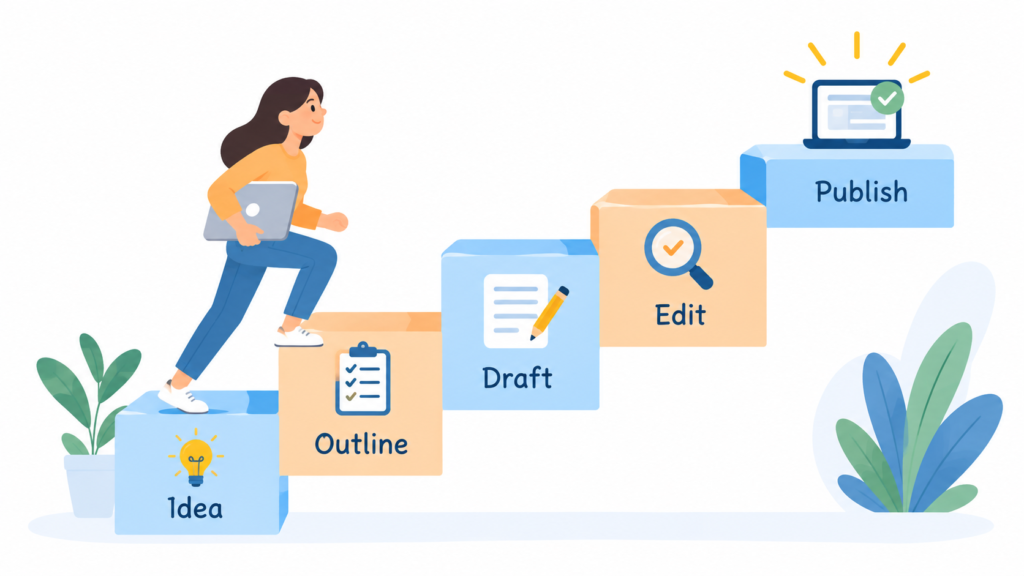
My First Blog Post Disaster (And What It Taught Me)
Let me be honest about what went wrong, because you can avoid every one of these problems.
My first post was titled “My Thoughts on Blogging.” Nobody searches for that. It had no keyword, no clear promise and no reason for a stranger to click. I wrote 1,400 words about my feelings, but I never answered a single question a reader might have.
The introduction was worse. I opened with three paragraphs about how excited I was to start my journey. Visitors left within seconds. I had no images, no subheadings and no meta description, so Google picked a random sentence from the middle of the post.
I also waited for perfection. I rewrote that post eleven times over two weeks, then published it and was crushed when nothing happened.
My second post was the turning point. I picked a specific question people were searching for, wrote a clear outline, answered the question in the first 100 words and added helpful formatting. That one post brought in more visitors in a week than my first post did in a year. My writing talent had not changed. Only my process had. That process is how to write first blog post for beginners in a way that avoids my early mistakes, and I’ll walk you through it now.
Before You Start: Three Things You Need to Know
You cannot write a great first post without knowing three basics. Take ten minutes to answer these before you open your editor.
1. Your niche. Your first post should fit the main topic of your blog. If you have not chosen one yet, read my guide on how to choose a blog niche for beginners first. A clear niche makes every writing decision easier.
2. Your reader. Picture one real person. Not “everyone who likes cooking,” but “a busy mom named Sara who wants 20-minute dinners.” When you write for one person, your writing becomes warmer and clearer.
3. Your goal. Decide what the post should do. Should readers subscribe, learn something or click a recommended product? One post, one goal.
With those answers ready, you can follow how to write first blog post for beginners with real direction instead of guessing.
Step by Step: How to Write First Blog Post for Beginners in 12 Simple Steps
Follow each step in order, and you will finish with a post that is helpful, easy to read and ready to rank.
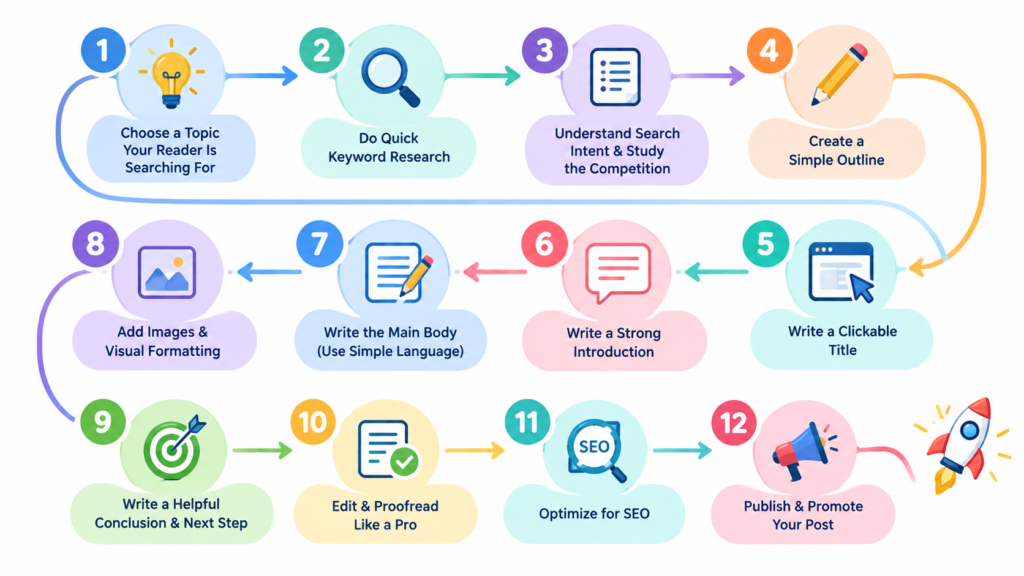
Step 1: Choose a Topic Your Reader Is Searching For
The biggest shift in my blogging career came when I stopped writing about what I felt like writing and started writing about what people wanted to know.
For your first post, pick a topic that is:
- Specific. “How to make sourdough starter at home” beats “Baking tips.”
- Helpful. It solves a clear problem or answers a clear question.
- Within your experience. You can write about it honestly and confidently.
- Beginner-friendly. Easier topics have less competition and are faster to finish.
List ten questions your ideal reader asks. Check Reddit, Quora, Facebook groups and Google’s “People Also Ask” boxes, then pick the one you can answer best. Avoid “Welcome to my blog.” It feels natural, but nobody searches for it.
My mistake: I once started “The Ultimate Guide to Everything About Fitness.” I got to 600 words, lost focus and abandoned it. A week later I wrote “How I Built a 15-Minute Morning Workout” in one afternoon, and it outperformed everything I had written before.
Step 2: Do Quick Keyword Research
A keyword is just the phrase people type into Google. You want a phrase that real people search for and that is not impossibly competitive.
Here is my five-minute method:
- Type your topic into Google and note the autocomplete suggestions.
- Check the “People Also Ask” box and the related searches at the bottom of the page.
- Use a free tool such as Google Keyword Planner or Ubersuggest to check search volume.
- Choose a long-tail phrase of four or more words with a clear intent.
My second post targeted a long phrase with modest search volume, and it ranked within three months. A broad one-word phrase would still be buried on page ten. For anyone learning how to write first blog post for beginners, long-tail keywords are your best friend.
My mistake: For my first two years, I skipped this step entirely. I published posts nobody searched for and wondered why traffic was flat. Ten minutes of research per post changed that.
Step 3: Understand Search Intent and Study Your Competition
Search intent is the reason behind a search. Someone who types “how to write first blog post for beginners” wants a clear, step-by-step tutorial. They do not want a history of blogging or a sales page. Give them what they want, and they stay.
Search your keyword and open the top five results. Ask yourself:
- What format do they use (list, tutorial, guide)?
- What questions do they answer?
- What do they miss or explain poorly?
- Are they long and detailed, or short and simple?
Do not copy them. Use the research to find the gap, then fill it with your own experience. That personal angle is what helps a new blog stand out against older, stronger sites.
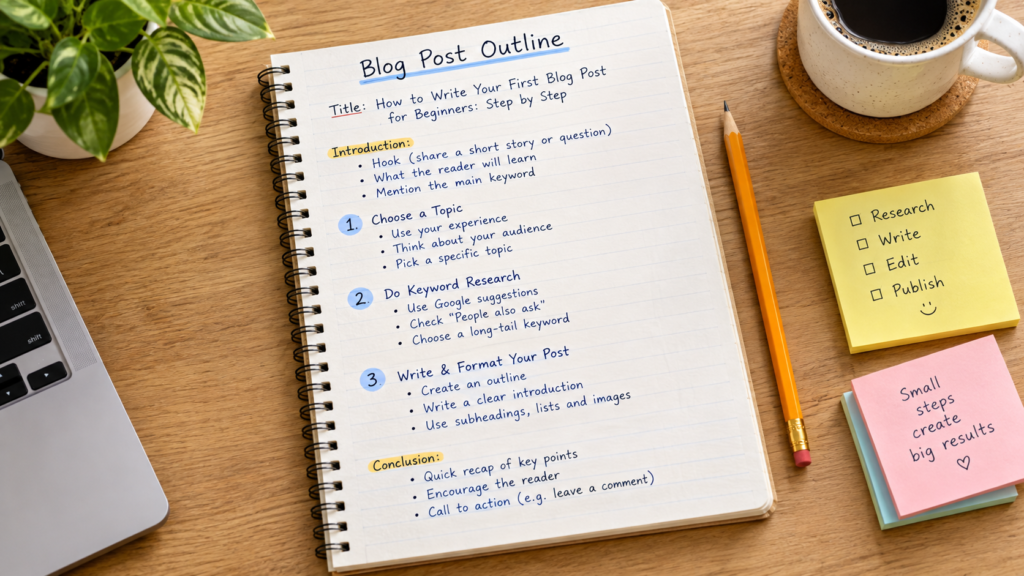
Step 4: Create a Simple Outline
This single step cut my writing time in half. If you want the easiest shortcut in how to write first blog post for beginners, this is it.
A simple outline has:
- A working title
- An introduction (what the post will help the reader do)
- 3 to 7 main sections, each with its own subheading
- A conclusion with a next step
Write the subheadings first, then add two or three bullet points under each. The outline does not need to be pretty. It only needs to show the path from the reader’s problem to the solution. When you sit down to write, you are no longer facing a blank page. You are filling in sections.
My mistake: I used to “write freely” and hope a structure would appear. It never did. My drafts were messy and took four times longer to edit.
Step 5: Write a Clear and Clickable Title
Your title decides whether someone clicks your link on Google or scrolls past. Good titles are clear first and clever second.
Use this simple formula:
Keyword + Benefit + Number or Hook
Examples:
- “How to Start a Garden in Small Spaces: 7 Easy Steps”
- “Beginner’s Guide to Budgeting: A Simple Plan That Works”
- “How to Learn Spanish Fast: 10 Habits That Actually Stick”
Put your main keyword near the beginning, keep the title around 60 characters or less so it is not cut off in search results, and promise something specific. My old title, “My Thoughts on Blogging,” promised nothing. “How to Start Blogging: 9 Beginner Mistakes to Avoid” would have done far better. Write five or six options and pick the clearest.
Step 6: Write a Strong Introduction
Readers decide within seconds whether to stay, so your introduction has to earn them. I use the “Hook, Problem, Promise” method:
- Hook: Start with a short story, a surprising fact or a direct question.
- Problem: Show that you understand what the reader is struggling with.
- Promise: Tell them exactly what they will learn or gain.
Keep it to 100 to 150 words and include your focus keyword in the first paragraph. Skip openers like “In today’s digital world…” and jump straight into the value.“A strong opening is one of the most important parts of how to write first blog post for beginners.”
Step 7: Write the Body and Add Your Own Experience
This is the heart of how to write first blog post for beginners. The body is where you deliver on the promise from your title and introduction.
Here are the rules I follow:
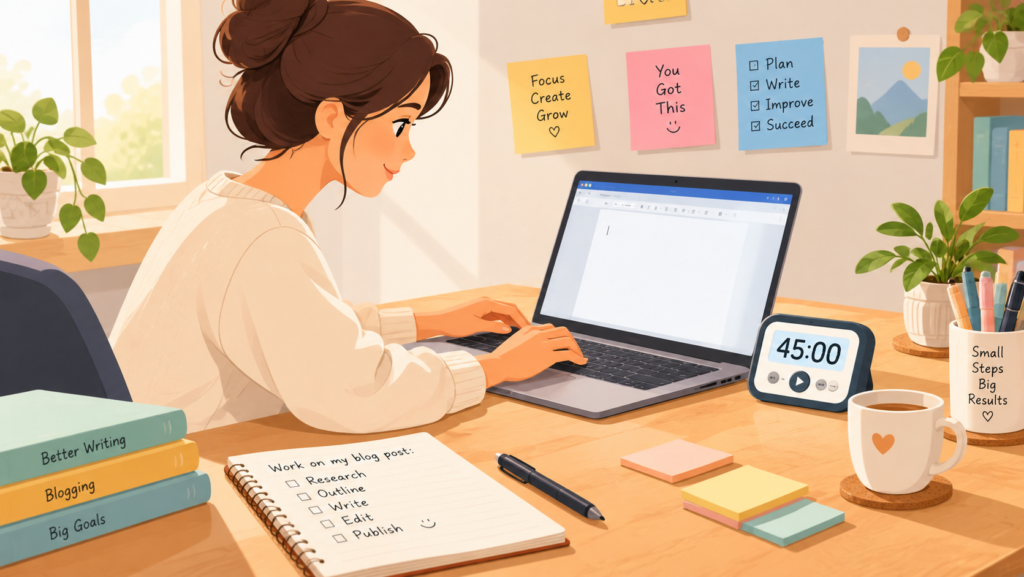
- Write the messy first draft first. Do not edit while you write. Set a 45-minute timer and keep typing.
- Write like you talk. Imagine explaining the topic to a friend. Use “you” and “I.”
- Keep paragraphs short. Two to four sentences is plenty, especially for phone readers.
- Use one idea per paragraph and a subheading every 200 to 300 words.
- Use bullet points and numbered lists for steps and options.
- Skip jargon, or explain it in plain words.
The most important rule is to add personal experience. Anyone can summarize information. Only you can tell your story. Mention what you tried, what failed, what surprised you and what you would do differently. Small stories work beautifully. I once added a short story about burning my first batch of cookies to a recipe post, and it became the most-commented paragraph on that blog.
This also matches what Google looks for. Its quality guidelines describe E-E-A-T: experience, expertise, authoritativeness and trustworthiness. Real stories show that a real person with real experience wrote your post.
A tip that saved me many hours: write the easy sections first. You do not have to write in order. If the introduction feels hard, skip it and return after the body is done.
My mistake: I once spent a whole weekend polishing a single paragraph. The post never went live. Now my rule is simple: finish first, polish second.
Step 8: Add Images and Visual Formatting
Images break up text, make your post feel professional and keep readers on the page longer. You do not need a camera or a design degree.
For your first post, aim for:
- One featured image at the top
- One image every 300 to 400 words
- Simple graphics such as screenshots, checklists or diagrams
Free tools like Canva and free stock sites make this easy. Compress images before uploading so your page loads quickly, and add descriptive alt text to each one. Alt text helps screen-reader users and also helps your post appear in image search.
Only use images you have the right to publish. I once received a warning about a picture I had copied from another website. Now I use my own photos, licensed stock or images I create myself.
Step 9: Write a Helpful Conclusion with a Next Step
Many beginners end with “Thanks for reading” and stop. That wastes your best chance to guide the reader.
A strong conclusion has three parts:
- A quick recap of the main points in one or two sentences
- Encouragement that makes the reader feel they can do it
- One clear next step, such as reading a related post, joining your email list or leaving a comment
Pick one call to action, not five. When I started ending posts with one simple question, my comments went from zero to a few per week.
Step 10: Edit and Proofread Like a Reader
Never publish a first draft. Editing is where good posts become great, and it is a core part of how to write first blog post for beginners.
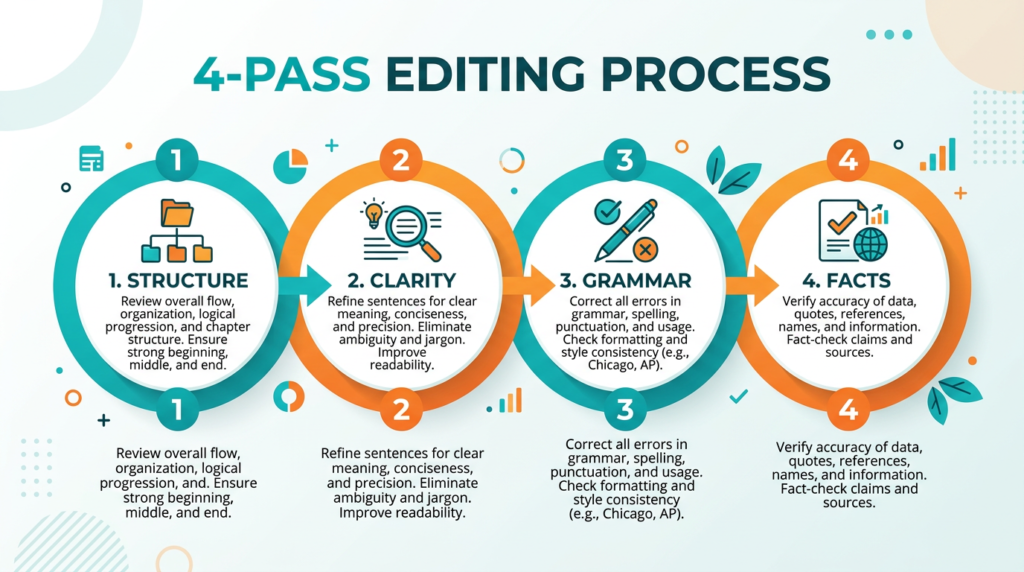
My editing routine has four passes:
- Structure: Does the post flow logically? Move or delete anything that does not belong.
- Clarity: Cut long sentences and replace complicated words with simple ones.
- Grammar: Use a free tool such as Grammarly or the built-in checker in your editor, then read the post out loud. If you stumble over a sentence, rewrite it.
- Facts and links: Double-check numbers and claims, and add links to trustworthy sources.
Take a break before editing, even a few hours. Fresh eyes catch what tired eyes skip. Proofread the title and headings last. I once published a post with the wrong brand name in the title, and it stayed live for three days until a reader emailed me.
Step 11: Optimize Your Post for SEO
On-page SEO means making your post easy for Google to understand. Use this checklist when you learn how to write first blog post for beginners:
- Focus keyword in the title, the first paragraph and at least one subheading
- A short, clean URL such as /how-to-write-first-blog-post
- A meta description of about 150 to 160 characters that includes your keyword
- Alt text on every image
- Internal links to your other posts, once you have more than one
- One to three external links to trusted sources
- Proper headings: one H1, then H2s and H3s in order
- A mobile-friendly layout
If you use WordPress, a plugin like Rank Math or Yoast will walk you through this list. Do not chase green lights. Write for people first, then use the tool to catch what you missed.
My mistake: Early on, I repeated my main keyword so often that my posts sounded robotic and my rankings dropped. When I rewrote them naturally, they recovered within a couple of months.
Step 12: Publish and Promote Your Post
Hitting “Publish” is only half the job. A new blog has no audience, and Google will not send visitors for a while, so you have to bring the first readers yourself.
Before you click, run a final check: clear title, images with alt text, working links, a meta description and a clean mobile preview. Then publish, and try these steps in the first week:
- Share it on social media where your reader spends time, such as Pinterest, Facebook groups or LinkedIn.
- Answer questions in communities and link to your post only when it truly helps.
- Ask friends and family for honest feedback.
- Submit your URL to Google Search Console so Google finds it faster.
- Create two or three Pinterest pins, especially in visual or lifestyle niches.
Do not expect instant traffic. My second post took three months to rank. What matters is that you published, shared it and moved on to the next one.
A Simple Blog Post Template You Can Copy
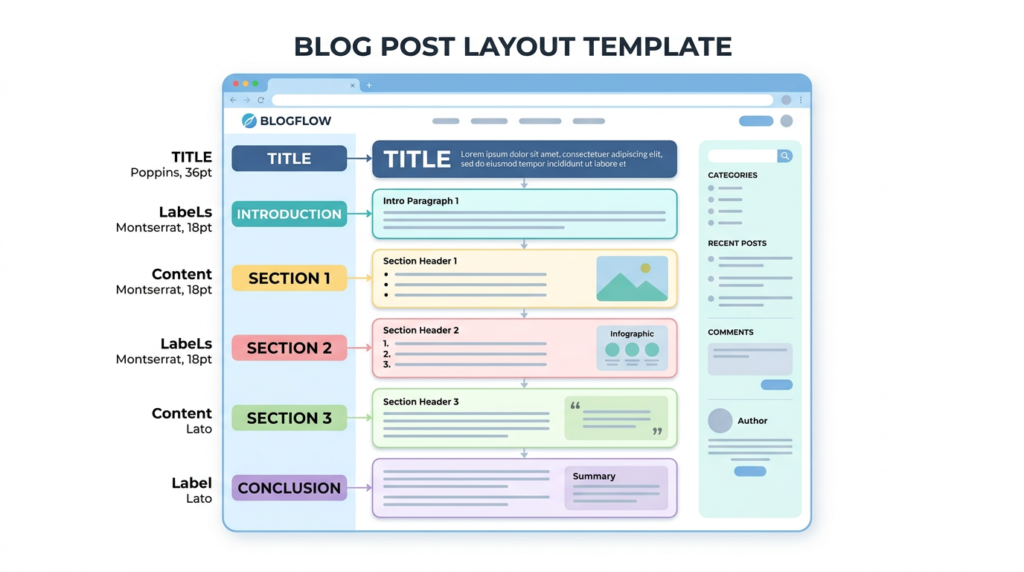
If you still feel nervous, use this structure. It works for almost any beginner topic and gives you a clear shape for how to write first blog post for beginners without stress.
Title: Keyword + benefit + number
Introduction (100 to 150 words): Hook, problem, promise (and keyword)
Section 1: The basics. What the reader needs to know first.
Section 2: The step-by-step process. Your main teaching.
Section 3: Common mistakes. Your own stories.
Section 4: Examples or tools. Make it practical.
Conclusion (80 to 120 words): Quick recap, encouragement, one next step.
Copy this into a blank document, replace each part with your own ideas, and you will finish faster than you expect.
10 First Blog Post Ideas for Beginners
Still stuck on what to write? These ideas work for almost any niche:
- “How to [solve a common problem] in [number] steps” (a tutorial)
- “[Number] mistakes beginners make in [your topic]” (a mistakes post)
- “My experience with [something you tried]” (a personal story with lessons)
- “The best tools for [task] on a budget” (a resource list)
- “[Topic] for beginners: a complete guide” (a beginner’s guide)
- “[Option A] vs [Option B]: which is better for beginners?” (a comparison)
- “What I wish I knew before starting [your topic]” (a lessons post)
- “A simple checklist for [task]” (a checklist)
- “[Number] common myths about [your topic]” (a myth-busting post)
- “How I [achieved a result] and how you can too” (a case study)
A tutorial or beginner’s guide is usually the safest first post. Both match what people search for, and both are easy to structure.
Biggest Mistakes to Avoid
Beyond the stories above, these are the mistakes I see beginners repeat most often:
- Writing a “Welcome to my blog” post. Start with a helpful topic instead.
- Writing about yourself instead of the reader. Focus on solving a problem.
- Skipping the outline and the keyword research. Both take minutes and save hours.
- Writing giant paragraphs. Short paragraphs keep readers on the page.
- Forgetting the call to action, the meta description or the alt text.
- Not promoting the post. I assumed Google would deliver readers for free. It did not, at least not for months.
- Copying other blogs. Use other posts for inspiration, never for copying.
- Giving up too soon. My first five posts got almost no traffic. The sixth began ranking.
If I could go back, I would follow this process on day one and publish within a week.
Real Examples: Beginners Who Wrote a Great First Post
Seeing the method in action helps. Here are three examples from bloggers I have mentored, with details simplified.
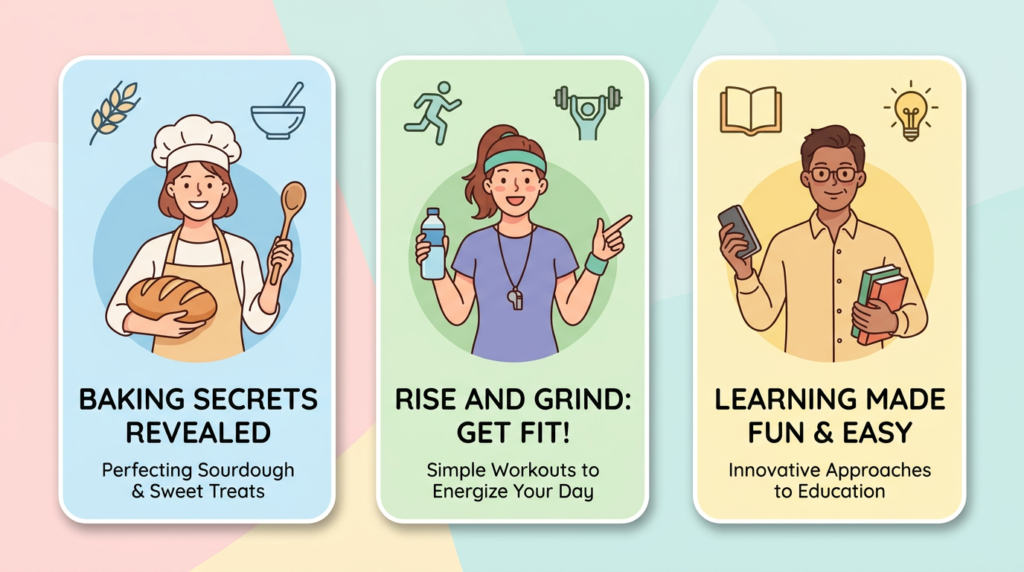
Lena, the home baker. Lena wanted to write about “my baking journey.” I asked her to choose one question her readers had instead. She wrote “How to Make Soft Sourdough Bread at Home: 7 Beginner Steps,” with step-by-step photos and a troubleshooting section. That post is now her top traffic source.
Omar, the fitness coach. Omar’s first draft was a 500-word introduction about himself. We replaced it with “Beginner Home Workout Plan: 20 Minutes, No Equipment,” and added clear subheadings and a downloadable checklist. He collected his first 40 email subscribers from that one post.
Sophie, the new teacher. Sophie knew teaching but doubted her writing. She wrote “How to Plan Your First Week of School” using her own mistakes as stories. Her honesty resonated, and the post was shared in several teacher groups within days.
Notice the pattern. None of them wrote about themselves first. Each picked a specific problem, used a simple structure and shared real experience. That pattern is the heart of how to write first blog post for beginners successfully.
How Long Should Your First Blog Post Be?
The honest answer: as long as it needs to be to fully help the reader, and no longer.
- Simple topics: 800 to 1,200 words
- Standard how-to posts: 1,200 to 2,000 words
- Complete beginner guides: 2,000 to 3,000 words or more
Check the top results for your keyword and aim to be equally thorough, or slightly more, but never pad with filler. A clear 1,200-word post beats a bloated 3,000-word one. If you are still learning how to write first blog post for beginners, do not stress about word count. Focus on answering the reader’s question completely.
What If You Feel Like You Cannot Write Well?
Almost every beginner tells me, “I’m not a good writer.” I believed the same thing. Blog writing is not school essay writing. Good blog writing is simple, clear and friendly.
You can improve quickly if you:
- Write the way you speak, with short words and short sentences.
- Read your work out loud and rewrite anything that sounds stiff.
- Use a voice recorder to speak your first draft, then clean up the transcript.
- Read great bloggers in your niche and notice how they structure posts.
- Practice daily. Even 15 minutes builds the habit.
Your voice does not need to be fancy. It needs to be honest. When I stopped trying to sound “professional” and started sounding like myself, my engagement improved.
What to Do After You Publish Your First Post
You published. That is a big step. Here is what I recommend next:
- Check your post on your phone. Most readers will view it on mobile.
- Fix any mistakes you spot. You can edit a post anytime.
- Set up Google Search Console and Google Analytics to track your traffic.
- Write your next post. A schedule of one post per week is a good start.
- Update your first post after 30 to 60 days. Add new information, strengthen weak sections and link to your newer posts.
My first properly optimized post got 11 visitors in its first week. After I updated it and improved the keywords, it grew to over 200 a week within three months. Blogging rewards patience.
Quick Checklist: Is Your First Blog Post Ready to Publish?
Before you hit the button, check these:
- Does the title include my keyword and promise a benefit?
- Does the introduction hook the reader and include the keyword?
- Is the post organized with clear subheadings?
- Are my paragraphs short and easy to read on a phone?
- Did I add a personal story or example?
- Did I add images with alt text?
- Is there a clear conclusion with one next step?
- Did I write a meta description with my keyword?
- Did I proofread everything, including the title?
If you answered “yes” to at least eight of nine, you are ready. This list sums up how to write first blog post for beginners in one place, so save it.
FAQs About How to Write First Blog Post for Beginners
1. How do I start writing my first blog post?
Choose a topic your reader is searching for, then build a simple outline. Writing the subheadings first removes the fear of the blank page.
2. What should my first blog post be about?
Choose a specific, helpful topic in your niche, such as a beginner tutorial or a “mistakes to avoid” post. Skip “Welcome to my blog” posts, since nobody searches for them.
3. How long does it take to write a blog post?
For a beginner, a 1,500-word post often takes four to six hours, including research, writing and editing. With practice, it becomes much faster.
4. Do I need SEO knowledge to write my first post?
You only need the basics: a clear keyword, a good title, subheadings, a meta description and image alt text. You can learn the rest over time.
5. Can I use AI to help write my first blog post?
AI can help with brainstorming and outlines, but your post should include your own experience, opinions and examples. That is what makes content trustworthy and different from everyone else’s.
6. How often should I publish after my first post?
Choose a schedule you can keep, such as one post per week. Consistency matters more than speed.
7. Is it okay if nobody reads my first post?
Yes. Almost every blogger starts with little or no traffic. Keep publishing and improving, and traffic builds over time.
Final Thoughts on How to Write First Blog Post for Beginners
If you remember only one thing from this article, let it be this: your first blog post does not need to be perfect. It needs to be published. A helpful, clear, honest post that exists will always beat a flawless one sitting in your drafts folder.
To recap, here is how to write first blog post for beginners step by step:
- Choose a topic your reader is searching for
- Do quick keyword research
- Understand search intent and study the competition
- Create a simple outline
- Write a clear, clickable title
- Write a strong introduction
- Write the body and add your own experience
- Add images and visual formatting
- Write a helpful conclusion with a next step
- Edit and proofread
- Optimize for SEO
- Publish and promote
I made nearly every mistake possible in my first year, and each one cost me time. You now have the shortcut. Open a blank document today, write your working title and build your outline. Momentum matters more than certainty.
Keep showing up. The post you write this week could be the one that starts your blogging career.

1 thought on “How to Write First Blog Post for Beginners: Step by Step”